Showing posts with label class. Show all posts

Wednesday, November 12, 2014

Class A EL84 6BQ5 Push Pull Tube Amp

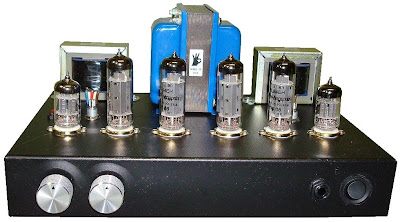
Bruce Heran of OddWatt Audio has shared another of his great sounding OddWatt amplifier designs with the DIY community. His latest amplifier project shares a similar topology with the other OddWatt tube amplifier projects available on the DIY Audio Projects website. His latest project is similar to the first Push-Pull EL84 (6BQ5) Oddwatt project posted two years ago. Both of the tube amp projects use EL84 (6BQ5) vacuum tubes in the output stage. The first OddWatt amplifier used a ECC802S SRPP driver stage while this one uses a 5751 SRPP driver stage. The main difference between the two amps is that this one uses smaller Edcor audio output transformers making it easier and less costly to build. A photo of the finished amplifier project is shown below (click on the photo for an enlargement).

5751
There are a number of improvements to the circuit. With the 5751 driver stage the higher gain of the new tube amp will allow for direct connection of portable MP3 players. The amplifier will produce about 5 to 7 watts of high quality sound with good performance between about 25 Hz to beyond 20kHz. The new amplifier measures very well and Bruce reports that the amp sounds very good with clean, detailed mids and highs and a great sound stage. Complete details for this project are available from the 5751 SRPP / EL84 (6BQ5) Push-Pull DIY Tube Amplifier project page.

Read More..

Tuesday, September 9, 2014

Class A amplifier Wiring diagram Schematic

This is the simple Class-A amplifier Circuit Diagram. This schema allows a class-A amplifier to drive a low impedance speaker and has a low quiescent current. The 220R in series with the speaker limits the "wasted" current to about 20mA max as the transistor is generally biased at mid-voltage.

 Class-A amplifier Circuit Diagram


Class-A

However the transistor will be almost directly driving the speaker when a signal is being processed and the only limitation is the ability of the 220R to discharge the 100u during each cycle.The schema is called a signal by-pass as the signal by-passes the 220R and drives the speaker directly (via the 100u).
Read More..

Thursday, September 4, 2014

Class one Headphone Amplifier

This Class one Headphone Amplifier schema is derived from the Portable Headphone Amplifier featuring an NPN/PNP compound pair emitter follower output stage. An improved output driving capability is gained by making this a push-pull Class-A arrangement. Output power can reach 427mW RMS into a 32 Ohm load at a fixed standing current of 100mA. The single voltage gain stage allows the easy implementation of a shunt-feedback schemary giving excellent frequency stability.
.
Circuit diagram :
Class-A
Class-A Headphone Amplifier Circuit diagram

The above mentioned shunt-feedback configuration also allows the easy addition of frequency dependent networks in order to obtain an useful, unobtrusive, switchable Tilt control (optional). When SW1 is set in the first position a gentle, shelving bass lift and treble cut is obtained. The central position of SW1 allows a flat frequency response, whereas the third position of this switch enables a shelving treble lift and bass cut.
.
Note:
  • Before setting quiescent current rotate the volume control P1 to the minimum, Trimmer R6 to zero resistance and Trimmer R3 to about the middle of its travel.
  • Connect a suitable headphone set or, better, a 33 Ohm 1/2W resistor to the amplifier output.
  • Connect a Multimeter, set to measure about 10Vdc fsd, across the positive end of C5 and the negative ground.
  • Switch on the supply and rotate R3 in order to read about 7.7-7.8V on the Multimeter display.
  • Switch off the supply, disconnect the Multimeter and reconnect it, set to measure at least 200mA fsd, in series to the positive supply of the amplifier.
  • Switch on the supply and rotate R6 slowly until a reading of about 100mA is displayed.
  • Check again the voltage at the positive end of C5 and readjust R3 if necessary.
  • Wait about 15 minutes, watch if the current is varying and readjust if necessary.
Parts List :
.
P1 : 22K Dual gang Log Potentiometer 
R1 : 15K
R2 : 220K
R3 : 100K
R4 : 33K
R5 : 68K
R6 : 50K
R7 : 10K
R8,R9 : 47K
R10,R11 : 2R2
R12 : 4K7
R13 : 4R7
R14 : 1K2
R15,R18 : 330K
R16 : 680K
R17,R19 : 220K
R20,R21 : 22K
C1,C2,C3,C4 : 10µF/25V
C5,C7 : 220µF/25V
C6,C11 : 100nF
C8 : 2200µF/25V
C9,C12 : 1nF
C10 : 470pF
C13 : 15nF
D1 : LED
D2,D3 : 1N4002
Q1,Q2 : BC550C
Q3 : BC560C
Q4 : BD136
Q5 : BD135
IC1 : 7815
T1 : 15CT/5VA Mains transformer
SW1 : 4 poles 3 ways rotary Switch
SW2 : SPST slide or toggle Switch
 

Read More..

Thursday, August 28, 2014

TDA8920 2x100W class D power amplifier

Description of TDA8920:

The TDA8920B is a high efficiency class-D audio power amplifier with very low dissipation. The typical output power is 2 × 100 W. The device is available in the HSOP24 power package and in the DBS23P through-hole power package. The amplifier operates over a wide supply voltage range from ±12.5 V to ±30 V (±32 V non operating) and consumes a very low quiescent current. The TDA8920B is a two channel audio power amplifier using class-D technology. The audio input signal is converted into a digital pulse width modulated signal via an analog input stage and Pulse Width Modulation (PWM) modulator. To enable the output power transistors to be driven, this digital PWM signal is applied to a control and handshake block and driver circuits for both the high side and low side. In this way a level shift is performed from the low power digital PWM signal (at logic levels) to a high power PWM signal which switches between the main supply lines. A 2nd-order low-pass filter converts the PWM signal to an analog audio signal across the loudspeakers. The TDA8920B one-chip class-D amplifier contains high power D-MOS switches, drivers, timing and handshaking between the power switches and some control logic. For protection a temperature sensor and a maximum current detector are built-in. The two audio channels of the TDA8920B contain two PWM modulators, two analog feedback loops and two differential input stages. It also contains circuits common to both channels such as the oscillator, all reference sources, the mode functionality and a digital timing manager.

Features TDA8920:
  • Zero dead time switching 
  • Advanced current protection: output current limiting 
  • Smooth start-up: no pop noise due to DC offset 
  • High efficiency 
  • Operating supply voltage from ±12.5 V to ±30 V 
  • Low quiescent current 
  • Usable as a stereo Single-Ended (SE) amplifier or as a mono amplifier in Bridge-Tied Load (BTL) 
  • Fixed gain of 30 dB in Single-Ended (SE) and 36 dB in Bridge-Tied Load (BTL) 
  • High output power 
  • High supply voltage ripple rejection 
  • Internal switching frequency can be overruled by an external clock 
  • Full short-circuit proof across load and to supply lines 
  • Thermally protected

Applications:
  • Television sets 
  • Home-sound sets 
  • Multimedia systems 
  • All mains fed audio systems 
  • Car audio (boosters)

Circuit diagram TDA8920:
TDA8920 2x100W class-D power amplifier
   

Datasheet for TDA8920: Download
Where you can buy: Aliexpress
Where you can buy: DealExtreme
Read More..

Friday, August 15, 2014

Class A headphone amplifier

Class A headphone amplifier
Read More..